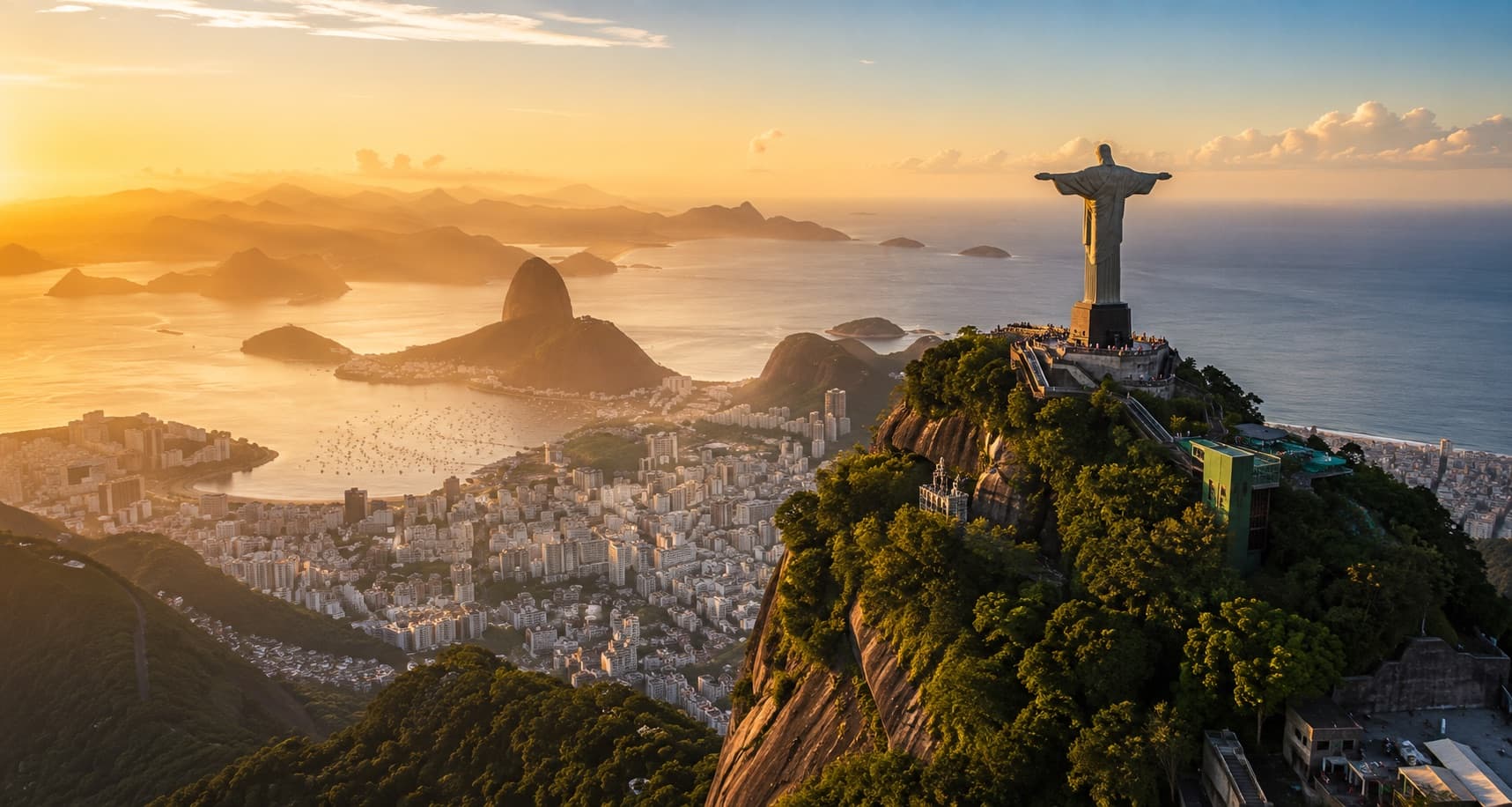
Headquartered in Rio de Janeiro. Metropolitan Rio scope in the initial phase. Declared expansion horizon into Brazil and Latin America across the first decade.
Why we exist
Brazil has three of the four legs that sustain productive economies rising from emerging to central. It has productive capacity. It has human capital. It has political articulation, insufficient but present. What it lacks is the fourth leg — a Brazilian strategic editorial apparatus with internal perspective, long-term institutional capital mandate, and declared independence from any controlling figure. That leg, at the scale Brazil requires, does not yet exist.
Âncora exists to build that leg. Not alone. Together with Farol — an independent editorial platform carrying authorial voice — and with the Rio Financial Centre, an institutional project channeling capital toward defensible Brazilian verticals.
We work with a ten-year horizon. Not because it is ambitious. Because that is how long serious institutions take to mature.
How we operate
We operate across five connected layers.
The institutional layer convenes government, international institutional capital, industry, and academia. It maintains regular conversations with the Rio de Janeiro City Hall, the State Government, BNDES, ApexBrasil, and relevant Ministries. It engages Brazilian and international family offices, sovereign wealth funds, and multilateral development institutions. It does not raise capital directly. It articulates.
The editorial and intelligence layer is Farol — an independent platform with declared firewall. It publishes weekly analysis, monthly roundtables, quarterly reports, an annual summit, and an annual international mission. It covers the Âncora ecosystem with the same editorial standard it applies to any other actor in the market.
The Rio Financial Centre operational layer is where institutional work translates into concrete economic transformation. Five defensible verticals. Four governance layers. Ten-year timeline.
The community and activation layer hosts gatherings, satellite programming, and exchange spaces with the Brazilian entrepreneurial and creative ecosystem.
The territorial impact layer maintains operational commitment to the Baixada Fluminense (Rio's metropolitan periphery) and the state's interior as the productive base of the institutional work. This layer is not accessory. It is the difference between a showcase platform and an actual transformation mechanism.
What differentiates us
We are private and independent. We are not a government-of-the-moment initiative. Our architecture is designed to survive any administration — from day one.
We work under plural governance. Our board holds a private and technical majority. Founders have voice, not absolute control. This constrains velocity and extends durability — a deliberate trade-off.
We maintain declared editorial firewall. Farol is not Âncora's communications outlet — it is an independent editorial platform that covers Âncora critically when warranted. Without this distinction, we would lose institutional credibility within months.
We do not manage capital directly. We work with qualified market managers — Opportunity, Guelt, BTG, and equivalent partners — who structure financial vehicles when appropriate. Each party charges for what it does. We articulate. They manage.
We work with Rio de Janeiro as gateway, not as isolated stage. Our metropolitan mandate includes Duque de Caxias, Itaguaí, Nova Iguaçu, Belford Roxo, Magé, Niterói, and other cities across the Rio de Janeiro axis. Without the Baixada Fluminense, there is no Rio Financial Centre — only a showcase.
The five verticals
Our institutional specialization thesis rests on five verticals where Rio, and by extension Brazil, holds structurally defensible advantage.
Energy transition and climate capital. Rio is home to Petrobras, home to Eletrobras, and operational base for the global energy companies operating in Brazil. It is where the industry that will drive Brazil's energy transition through the next two decades already lives.
Ocean economy and port infrastructure. Ports of Rio, Itaguaí, Açu. Shipbuilding industry concentrated along the Niterói–Angra axis. Oceanographic research at UFRJ and the Brazilian Navy. Brazil has 8,500 kilometers of coastline; Rio is where its ocean economy institutionally consolidates.
Creative industries and intellectual property. Globo, the audiovisual market, the Brazilian musical spine, gaming, and animation. Rio generates more cultural intellectual property value than any other Brazilian city — and that value is systematically under-financialized.
Digital infrastructure. Rio AI City as a US$ 65 billion initiative across a decade. Undersea cables landing in Rio. Three gigawatts of available energy. Low latency to global markets. Physical infrastructure is being built; the financial infrastructure to sustain it remains open ground.
Impact capital and sustainable finance. BNDES headquarters. Presence of the LAB — Laboratory of Financial Innovation, Brazilian member of the FC4S. Rio is already Brazil's impact capital center. It simply is not narrated as such.
Where we stand today
This is a project under public construction. We have no AUM to display. We have no decades of track record to cite. What we do have:
Active conversation with Invest.Rio and Rio de Janeiro City Hall on the Rio Financial Centre. Institutional dialogue with BNDES. Engagement with ApexBrasil and relevant Ministries. First quarterly Farol report in preparation. First summit planned for the Web Summit Rio 2027 as institutional launch event.
We operate with transparency about stage. Every statement on this site is verifiable or explicitly aspirational. Institutional trust is built through consistency between what is said and what is done — and every exaggeration paid for later destroys more than any achievement replaces.
Invitation
If you are institutional capital evaluating long-term Brazilian allocation, if you are a public actor articulating regional development, if you are a Brazilian company interested in participating in a larger architecture — a conversation is worth having.
Our work is a decade long. The first conversations are the ones that ground that decade. We are available.